






Academic Research

Power an additive manufacturing revolution through experimentation, validation, and knowledge transfer.

Leverage the world’s most flexible metal AM research platform

It’s true that Cold Spray has been used for over a century for coatings and repairs, but our system is the only true end-to-end Cold Spray Additive Manufacturing (CSAM) solution, enabling you to build parts directly from a CAD file or scan. Additionally, our open-system philosophy provides academic researchers with nearly unlimited avenues of inquiry.
  • Develop your own metal powders
  • Experiment with different elemental or alloy powders
  • Access all the print parameters to truly control each variable
  • Simulate everything with our proprietary TwinAPR software
By providing your details, you also consent to being included in APR Engineering newsletter and blog distribution list, and other communications about our products and updates. You may unsubscribe from these communications at any time. For information on how to unsubscribe and our commitment to protecting your privacy, visit our privacy policy.

Help us push the boundaries of CSAM

We’re actively looking for academic partners interested in taking full advantage of CSAM’s speed and flexibility to drive groundbreaking innovation. Our open systems enable you to accelerate research and publish more data.
  • Reach deposition rates of up to 100g/minute (3.5oz/minute)– a faster process means quicker results and more data to publish
  • Lower operating costs by sourcing metal powders from 3rd parties and eliminating the need for expensive gases
  • Minimize post-processing requirements down to heat treating and/or aging in electric furnaces

Accelerate training and workforce development

As industries continue to embrace additive manufacturing, the need for a skilled workforce will continue to rise. Because our printers operate at fast speeds and low operating costs, they provide a unique opportunity to maximize hands-on training in the classroom—and help fill this critical pipeline.
  • Enable students to make mistakes without exhausting your budget
  • Translate powder handling skills and safety training to LPBF and binder jetting
  • Access workforce development grants by teaching transferable skills across AM technologies

APR Engineering Customers

This investment emphasizes the importance of workforce development and collaboration between Missouri universities and manufacturers to embrace advanced manufacturing technologies.
The military approach to additive manufacturing (AM) offers critical insight for commercial manufacturers hoping to better understand and more effectively navigate legal regulations and industry standards.
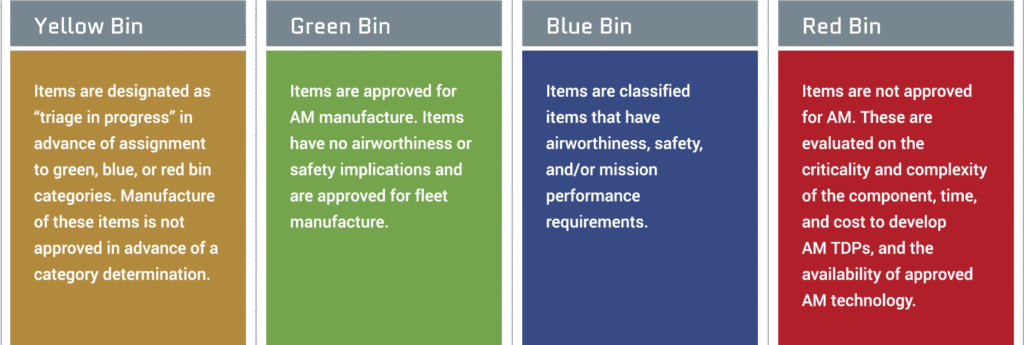
The U.S. Marine Corps uses a color-coded bin system that serves as an excellent model. And by understanding how the branch uses it to assess the risk levels of metal parts, you can better identify—and resolve—potential Intellectual Property challenges.

In many countries, IP rights granted to spare parts are limited as patent protection typically applies to machines rather than to spare parts.

The doctrines of ‘exhaustion’ and ‘implied license’ allow the purchaser of a patented product to use, re-sell, and repair that product without the patent holder’s permission. However, it’s crucial to ensure that additive-manufactured parts are not subject to any patents or other IP protections. Consulting a legal professional and conducting thorough research can help you avoid any legal issues.

It’s also important to note that design protection and the ‘right to repair’ may vary from country to country, with some providing greater leniency for repairing and maintaining complex products.

In the U.S., ‘right to repair’ bills are under consideration but have yet to become law. Meanwhile, though copyright law typically doesn’t protect mass-produced machine parts or functional items, infringement may occur if OEM drawings are used to create the spare part.

When it comes to legal compliance, the most critical factor to consider is your equipment supplier contracts. Ensuring that your contracts allow for the use of AM technology for spare parts production and do not infringe upon IP rights can help you maintain a compliant manufacturing process.
By carefully navigating IP and legal concerns in collaboration with your equipment supplier and legal counsel, you can harness the potential of metal AM to produce spare parts while minimizing the risk of legal issues.

Contact Us

We’re ready to help you bring your metal additive manufacturing application to life. Let’s get started.

Machinery Studies

See our applications in action.

Careers Center

Get everything you need to cover the APR story.

Scroll to Top

Industries

Contact

Contact Us

World headquarters Melbourne, Victoria, Australia Research & development Darwin, NT, Australia

Follow Us